
Minoxidil for Women: Is 2% or 5% Right?

Buy the wrong strength and one of two things happens: nothing, or a face full of fine new hair nobody asked for. Minoxidil for women isn't simply a weaker version of the men's product wearing pink packaging, and the 2% versus 5% question has a real, evidence-based answer that most product pages skip straight past.
On this page:
- Female pattern hair loss: what's actually happening
- Minoxidil 2% vs 5% for women: the real difference
- Foam or lotion: the women's format question
- Women's minoxidil products at a glance
- A realistic results timeline
- Holding ground counts, and how to measure it
- If nothing has changed
- Side effects women should know about
- Can women use men's 5% products?
- Frequently asked questions
Female pattern hair loss: what's actually happening
Female pattern hair loss doesn't look like the receding hairline most people picture when they hear "hair loss". It's usually a widening part, a scalp that shows through more under bright light, and an overall reduction in density across the crown, while the frontal hairline is often left largely intact. It's driven by a shrinking of individual hair follicles over successive growth cycles, a process called miniaturisation. DermNet NZ's overview of female pattern hair loss sets out the typical presentation, and our page on female pattern hair loss covers recognition, onset age and what it gets mistaken for.

It's worth ruling out the look-alikes before assuming this is what's happening to you. Sudden, all-over shedding a few months after illness, surgery or a stressful event is more likely telogen effluvium, which often resolves on its own, and our page on diffuse thinning versus pattern loss covers how to tell them apart. Thinning that arrives around the menopause has its own timing and its own options, covered in our page on menopause and hair thinning. If your pattern doesn't match gradual, diffuse thinning across the crown, it's worth a GP appointment before buying anything, as the NHS guidance on hair loss explains.
Minoxidil 2% vs 5% for women: the real difference
Here's the part that trips people up. With minoxidil, more concentration doesn't simply mean more result for women in the way it might seem to. The original women's licensed product was a 2% solution applied twice daily. Later trials found that a 5% once-a-day foam produced comparable, and in some measures slightly better, regrowth than the 2% solution, while being more convenient to apply. That's why the current licensed women's foam is 5%, applied only once a day rather than twice.

The catch is dosing frequency, not raw percentage. A 5% product used once daily and a 2% product used twice daily deliver a broadly similar total exposure across the day. Doubling the strength and also doubling the frequency, which is what the men's twice-daily 5% products do, pushes total exposure meaningfully higher, and that's the combination linked to a higher rate of unwanted fine hair growth on the face in some women. The official Regaine for Women Once a Day Scalp Foam 5% patient leaflet sets out this dosing pattern and the reasoning behind it.
The schedules differ for a reason, in other words, and it isn't a marketing decision dressed up as a medical one. The women's regimens were tested and licensed at the exposure that balanced effect against the risk of hair growing where nobody wanted it; the men's were tested at a higher one. There's a second, quieter reason too: female pattern loss usually presents as diffuse thinning with the hairline preserved rather than a receding front, so the treatment goal and the area being treated differ even though the drug does not.
In practice this gives most women three sensible options: a 2% lotion twice daily, a 5% foam once daily, or a 2% foam once or twice daily depending on the product. None of these is objectively "stronger" once frequency is factored in. For the fuller picture of how strength and formulation interact across the whole range, our guide to minoxidil 5% is a useful companion read.
Foam or lotion: the women's format question
Lotion is applied with a dropper, worked into the parting, and left to dry before styling. It's precise and cheap to produce, but the propylene glycol used as a solvent in many lotion formulas is a common cause of scalp itching and flaking, particularly with daily long-term use. Foam skips propylene glycol almost entirely, dries in minutes rather than hours, and tends to sit better under styling products, though it costs more to manufacture and therefore to buy. We cover the mechanics of that trade-off in our guide to minoxidil foam vs lotion.
For women specifically, format often comes down to hair length and styling habits as much as scalp sensitivity. Lotion applied with a fine dropper can be easier to direct precisely along a wide part on long hair, while foam's faster drying time suits anyone applying before work in the morning. Neither format changes how the drug works once it's on the scalp; the choice is genuinely about which one you'll use correctly, every day, without skipping it.
Women's minoxidil products at a glance
Compare these by cost per month rather than by the price on the box, since the pack sizes differ and minoxidil only holds a result while you keep using it.
| Product | Strength & format | Frequency | Price | Per month |
|---|---|---|---|---|
| Regaine Minoxidil Foam 5% for Women, 4-month | 5% foam | Once daily | EUR 89.99 | EUR 22.50 |
| Foligain Minoxidil Foam 2% for Women, 3-month | 2% foam | Once or twice daily per label | EUR 64.99 | EUR 21.66 |
| Regaine Minoxidil Lotion 2% for Women, 3-month | 2% lotion | Twice daily | EUR 79.99 | EUR 26.66 |
| Foligain Minoxidil Lotion 2% for Women | 2% lotion | Twice daily | EUR 54.99 | EUR 18.33 |
That last column is the one worth reading twice. The cheapest licensed route is the Foligain 2% lotion at roughly EUR 18.33 a month, which is around a third less than the Regaine 2% lotion at the same strength and the same twice-daily schedule. Our women's hair care range lists what's in stock, and the women's foams are grouped separately. Always check the patient leaflet that comes with your product rather than assuming it matches another brand at the same strength.
A realistic results timeline
Patience is the unglamorous part of this. DermNet NZ's overview of topical minoxidil puts visible regrowth at around four months for most users who respond, and that timeline doesn't shorten because you're using the higher-strength product. The first two to eight weeks typically show no visible change, and some women notice a temporary increase in shedding during this window as the hair cycle resets. That shedding is usually a sign the treatment is doing something, not a sign it's failing, though it understandably puts a lot of people off before the good part arrives.
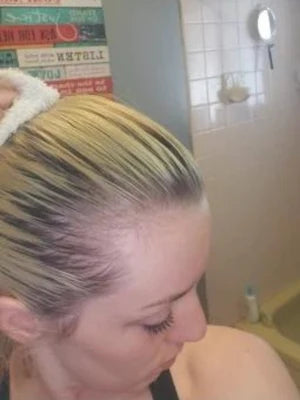
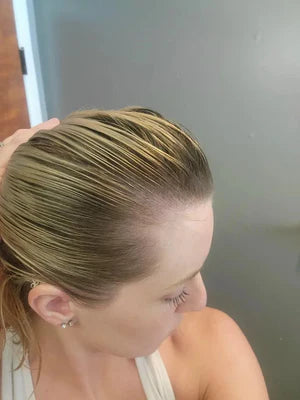
Customer progress photos: R.L., minoxidil 5% foam for women, after 5 months. Results vary. See more on our reviews page.
From around month four, fine, short vellus hairs can start appearing along the parting, thickening gradually over the following months. By month six to twelve, most women who are going to see a meaningful result will have a genuine before-and-after difference, particularly if compared under consistent lighting and from the same angle. Results plateau from there, and continued use is required to hold onto them: stopping typically means a return to the pre-treatment pattern within three to four months, a point our guide to how Regaine works month by month covers in more depth.
Holding ground counts, and how to measure it
This is the part most women reject, and it's the most common outcome. Female pattern hair loss is progressive. Without treatment, the parting keeps widening. If after a year on minoxidil your parting is the same width it was when you started, the treatment has done something real, even though nothing looks better than it did.
The comparison that matters is against where you would have been, not against where you were. That's impossible to see in a mirror and obvious in photographs. So take them: monthly, same place, same light, dry hair, no styling, including the parting from directly above, which is where the change happens.
Daily mirror checks are worse than useless during the first three months. Lighting, hair being wet or dry, and what you're hoping to see all swamp the actual difference, and during the shedding phase they'll convince you it's getting worse. Judge at month six against month zero, not week five against yesterday.
The other honest bound: follicles that have finished miniaturising don't restart. Treatment works on what's still active rather than on what's already gone, which is the argument for starting earlier rather than waiting to see whether it settles.
If nothing has changed
At six months of consistent, correct use with no change at all, including no slowing of the loss, the question worth asking is whether the diagnosis fits rather than whether to persist.
Hair loss in women has a wider range of causes than in men, and several are treatable in ways minoxidil cannot address. Thyroid problems and iron deficiency both present as thinning and both need a blood test. Shedding that followed pregnancy, illness or significant weight change is usually telogen effluvium, which resolves on its own. Before concluding it failed, check the mechanics too: whether the product is reaching your scalp rather than your hair, whether the dose has drifted, and whether there have been gaps. Our page on what to check after six months works through the usual causes in order.
Side effects women should know about
Scalp dryness, flaking and itching are the most common complaints, and they're often related to a lotion's propylene glycol content rather than the minoxidil itself, which is one reason some women switch to foam. Initial shedding, covered above, is common and usually settles within a few weeks.
Unwanted fine hair growth on the face, particularly the temples and upper cheeks, is the side effect most specific to women using minoxidil, and it's the main reason dosing schedules differ so carefully between the 2% twice-daily and 5% once-daily products. It's usually linked to product spreading beyond the treated area or to a higher-than-licensed total daily dose, and it typically fades over some months after stopping or adjusting application, though this isn't guaranteed for everyone.
Minoxidil is not recommended during pregnancy or breastfeeding, and our page on minoxidil in pregnancy and breastfeeding covers what to do if you're already using it. Rare but serious effects relate to minoxidil's original use as a blood pressure medicine: a fast or irregular heartbeat, chest pain, dizziness, or sudden unexplained weight gain. Stop and seek medical advice the same day rather than waiting to see. For the full breakdown, see our guide to minoxidil side effects.
Can women use men's 5% products?
Not without speaking to a pharmacist or doctor first, and generally the answer given will be no. It's the concentration and frequency together that matter rather than the brand, so a generic men's 5% lotion sits in exactly the same position as a branded one. Our page on whether women can use Kirkland's men's 5% covers what the label says, what to do if you've already been using it, and how to switch across without losing progress.
Frequently asked questions
Is 5% minoxidil safe for women, or should I stick to 2%?
Yes, when it's the product and schedule specifically licensed for women, which is a 5% foam used once daily. It's the twice-daily 5% schedule designed for men, not the strength alone, that raises the risk of unwanted facial hair growth in women.
Will 5% work faster than 2% for women?
Not meaningfully. Both strengths, used as licensed, deliver a broadly similar total daily dose, and the visible-growth timeline of around four months applies regardless of which one you choose.
Can I switch from the 2% lotion to the 5% foam partway through?
Many women do, usually for convenience or scalp comfort rather than because the 2% has "stopped working". It's simplest to finish your current bottle first so you always know what you're applying, and to ask a pharmacist if you're unsure how to transition between schedules.
Why do some women get facial hair growth on minoxidil and others don't?
It's not fully predictable, but it's more common with higher total daily exposure, product spreading beyond the scalp, or off-label use of men's twice-daily 5% products. Sticking to the licensed women's schedule for your chosen strength keeps exposure within the range it was tested at.
Does minoxidil help with all types of female hair thinning?
It's licensed for female pattern hair loss specifically. Sudden diffuse shedding or patchy bald spots have different underlying causes and need a different assessment, so it's worth confirming the pattern with a GP before starting.
Continue reading
More guides from the Hairdealz blog.


Ready to put it into practice?
Every order is covered by our 120-day money-back guarantee.


Leave a Comment